
Menopause isn't creating the leadership gap. It's accelerating it.
Workforce intelligence and practical support for Australian organisations ready to act on the data.
- Ready-to-deploy workforce intelligence
- Fair Work compliant
Workforce Intelligence for Boards and Executives
Menopause-age attrition: a data-led workforce intelligence approach for Australian employers
Menopause-age attrition is a measurable workforce risk, not a wellbeing issue. I turn it into three board-ready outputs, built on WGEA-verified data: a Midlife Workforce Health Score, a Menopause Super Penalty, and a Board-Ready Risk Brief. Together they show how menopause-age attrition widens workforce risk, leadership exposure and long-term financial loss, so you can act early.
- Midlife Workforce Health Score
- Menopause Super Penalty
- Board-Ready Risk Brief
- Built on WGEA-verified data
“Unmanaged menopause symptoms are driving hidden attrition and leadership loss among Australian women aged 45 to 60. My menopause-age workforce intelligence approach helps boards and executives quantify that risk more clearly — and act before it becomes embedded loss.”
Angie Wood
Founder, Menopause and Work™ · Author, National Workforce Intelligence Report 2025–26
The Frame
Why this is a workforce risk, not a soft issue
Australian leaders increasingly see how menopause symptoms show up at work, and how they can stall career progression just as women move into critical leadership, technical and client-facing roles. My workforce intelligence approach shifts this from an awareness conversation to something boards can act on: a clearer view of retention exposure, leadership pipeline pressure, replacement-cost risk and long-term superannuation consequences.
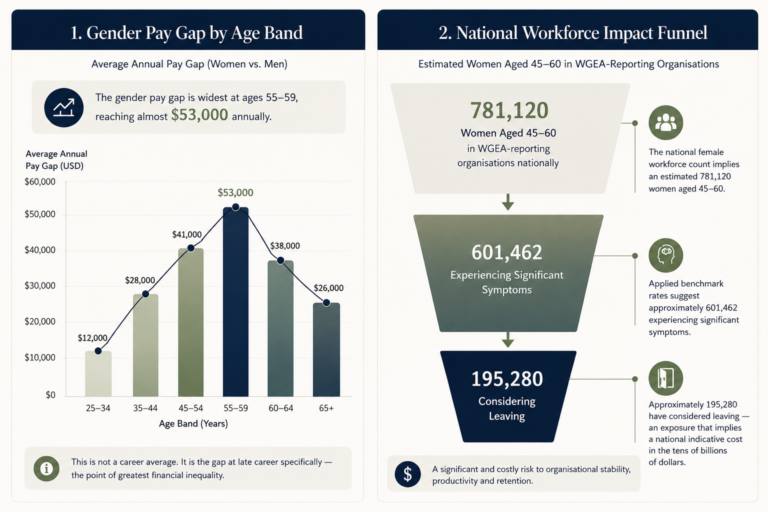
The superannuation impact is the long-tail financial consequence of this attrition, reduced hours and step-downs during women’s peak earning years, when the gender pay gap is already at its widest. That is why it belongs in workforce intelligence, not at the margins as a wellbeing issue.
The Evidence
What the national data reveals
My National Workforce Intelligence Report 2025–26 draws on WGEA data and workforce modelling to quantify menopause-age attrition across six major sectors. The findings point to a significant workforce, leadership and economic challenge.
WGEA data covers Australian employers with 100 or more employees.
For the C-Suite
Why this matters to CEOs and CFOs
01
Hidden attrition and replacement cost
Menopause-age exits, step-downs and reduced hours erode capability and weaken leadership pipelines, while appearing as ordinary turnover in your reporting.
02
Unpriced superannuation liability
Lost peak earning years materially reduce women’s super balances over time, creating a long-tail financial consequence tied to current employment practices.
03
Leadership, gender and fiduciary responsibility
These losses undercut stated goals on women’s leadership and pay equity, making menopause-age attrition a governance issue, not a wellbeing one.
04
A board-ready metric
The Midlife Workforce Health Score and Menopause Super Penalty sit alongside pay-gap, retention and leadership metrics, giving boards a clearer number to track.
01
Hidden attrition and replacement cost
Menopause-age exits, step-downs and reduced hours erode capability and weaken leadership pipelines, while appearing as ordinary turnover in your reporting.
02
Unpriced superannuation liability
Lost peak earning years materially reduce women’s super balances over time, creating a long-tail financial consequence tied to current employment practices.
03
Leadership, gender and fiduciary responsibility
These losses undercut stated goals on women’s leadership and pay equity, making menopause-age attrition a governance issue, not a wellbeing one.
04
A board-ready metric
The Midlife Workforce Health Score and Menopause Super Penalty sit alongside pay-gap, retention and leadership metrics, giving boards a clearer number to track.
The Deliverables
What your organisation receives
Three board-ready outputs. The formulas remain proprietary; the outputs give executives clear metrics and a practical basis for action.
01
Midlife Workforce Health Score (1–100)
Shows how well your organisation retains, progresses and protects women aged 45–60. Lower scores indicate greater exposure.
02
Menopause Super Penalty
An indicative, modelled estimate of the retirement savings loss linked to menopause-age attrition, reduced hours and step-downs, reported per woman and in total.
03
Board-Ready Risk Brief
A concise executive brief covering workforce continuity, leadership exposure and priority action.
Act early
Recognise the issue early — before it disappears into your turnover data.
Recognise the issue early, before it disappears into your turnover data.
Frequently Asked Questions
Get answers to common questions about implementing menopause support in your workplace.
Menopause-age attrition is the loss of experienced women from the workforce, or their move to reduced hours and more junior roles, driven by unmanaged menopause symptoms during the years they are typically most senior, roughly ages 45 to 60. Organisations often record it as burnout, career change or personal reasons, which hides it inside ordinary turnover data.
The Menopause and Work National Workforce Intelligence Report 2025-26 models replacement cost exposure at around $16.6 billion across six sectors: health care, education, financial services, retail, professional services and public administration. This is a modelled estimate built on WGEA-verified data and the 2024 Senate Menopause Inquiry. It covers WGEA-reporting employers with 100 or more staff, not all Australian businesses.
Yes. Menopause symptoms can affect confidence, attendance, hours and progression during the years when many women hold senior, experienced roles. When these women step down or leave, organisations lose leadership pipeline depth and capability, not just headcount.
We analyse your HR and pay data for women aged roughly 45 to 60 and map where exits, step-downs and reduced hours concentrate by business unit, role level and profession. You receive a midlife workforce health score, a menopause super penalty estimate and a board-ready pack.
The menopause super penalty estimates the likely retirement savings shortfall women may carry if menopause-related work changes, such as reduced hours or early exit, continue. We report it per woman and in total for the organisation.
The national figures draw on WGEA data, which covers reporting employers with 100 or more staff, not every Australian business. The national numbers are modelled estimates that show directional exposure. Your own engagement uses your organisation’s data for organisation-specific results.
No. This is a workforce intelligence and risk service for employers. It does not provide clinical or medical advice and does not replace individual health care.
It is designed for CEOs, CFOs and CHROs, and for organisations in health, community care, finance and education that suspect menopause is affecting retention and progression but cannot yet quantify the impact in their own workforce.
National figures cited here come from the Menopause and Work National Workforce Intelligence Report 2025-26. They are modelled estimates derived from WGEA-verified employer data (reporting employers with 100 or more staff), WGEA ages and wages data, and the 2024 Senate Menopause Inquiry. Modelled estimates indicate directional exposure across the sectors analysed and do not represent a verified count for any individual organisation.